The video showcases the dedicated team of attorneys at Fulmer Sill as they engage with clients and collaborate in their Oklahoma City office. Scenes highlight their commitment to providing top-notch legal services in their local community.

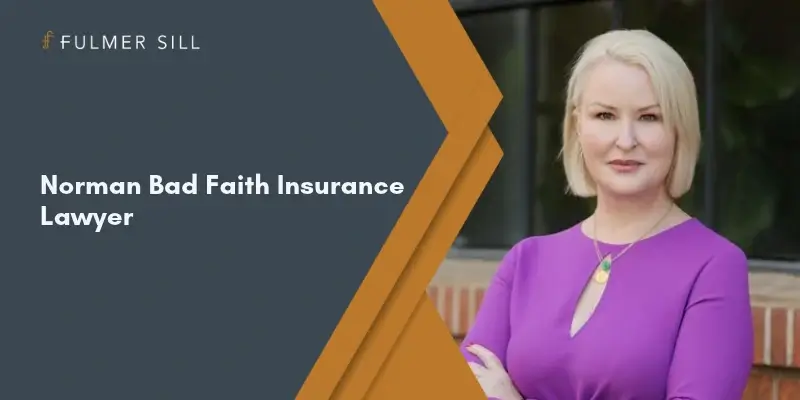
Norman Bad Faith Insurance Lawyer
Bad Faith Insurance Attorney in Norman, OK
When your insurance company delays, lowballs, or denies a claim you paid years of premiums to protect, the financial strain lands on you instead of the company that promised to cover it. Medical bills pile up, repair estimates sit untouched, and the gap between what you were promised and what you actually received keeps growing.
Simone Fulmer Gaus, a co-founding attorney at Fulmer Sill and a Norman bad faith insurance lawyer, has practiced law since 1996 and regularly presents on insurance bad-faith litigation across Oklahoma and nationally.
Her firm’s attorneys have helped secure more than $1 billion in combined settlements and verdicts for clients throughout their careers. Fulmer Sill has offices in Oklahoma City and Edmond to serve clients across the state, including Norman.
Our attorneys can review your policy, your denial letter, and your insurer’s communications to help you understand your options and what your claim may potentially be worth. Contact an experienced attorney at Fulmer Sill to discuss your case and understand your next steps.
Insurance Denials and Delays a Norman Bad Faith Insurance Attorney May Challenge
Not every denied claim is bad faith. Oklahoma law treats bad faith as a situation where an insurer acts unreasonably, without a legitimate basis, in denying, delaying, or underpaying what it owes. The claims a Norman bad faith insurance attorney reviews include:
- Auto insurance claims your own insurer denies or undervalues after a crash
- Homeowners and property claims delayed well past a reasonable investigation period
- Uninsured and underinsured motorist claims an insurer refuses to pay
- Disability insurance claims cut off or denied without a clear medical basis
- Your own liability insurer refusing to defend you when you are sued
- Settlement offers from your own insurer that fall far below the documented value of the loss
If your situation looks like any of these, it helps to have someone look at the full claim file rather than just the denial letter itself.
First-Party vs. Third-Party Insurance Claims in Oklahoma
Not every insurance dispute works the same way. Whether you can bring a bad faith claim depends on whether you are the insurer’s own policyholder or an injured person making a claim against someone else’s insurer.
First-Party Claims
A first-party claim is one you make against your own insurance company under a policy you purchased, such as auto, homeowners, disability, or uninsured/underinsured motorist coverage. An insured may pursue a bad faith claim against their own insurance carrier for unreasonable claims handling, such as unjustified delay, denial, or underpayment.
Third-Party Claims
A third-party claim is one an injured person makes against the at-fault party’s liability insurer, such as after a crash caused by another driver. An injured claimant generally cannot bring that same type of bad faith claim directly against the at-fault party’s third-party liability carrier. Instead, the injured person’s path is typically a personal injury claim against the at-fault party.
Why Does It Matter if a Denial Is Simply Wrong or Legally “Bad Faith”?
It matters because Oklahoma treats insurance bad faith as its own civil wrong, separate from an ordinary breach of contract. That distinction changes what you may recover. A straightforward contract claim generally limits you to the benefits your policy already owes you.
A bad faith claim can also open the door to compensation for the financial and emotional toll the insurer’s conduct caused. In cases involving especially reckless conduct, additional damages meant to punish the insurer rather than compensate you may be possible.
The clock on these claims moves fast. Under Okla. Stat. tit. 12, § 95, you generally have two years to file a bad faith claim, running from the date you knew, or reasonably should have known, that your insurer was acting in bad faith. However, there are some exceptions. An attorney can review your potential claim and advise you about the time you have to file a claim.
How Our Norman Bad Faith Insurance Lawyers Build Bad Faith Insurance Cases in Cleveland County
Oklahoma’s Unfair Claims Settlement Practices Act lists specific practices insurers are not allowed to use, including failing to attempt a prompt, fair, and equitable settlement once liability is reasonably clear. You cannot sue an insurer directly for breaking this law, but a violation can serve as evidence that the company’s conduct crossed into bad faith.
Our attorneys bring 200+ combined years of legal experience to evaluating these claims. We look at the full claim file, the timeline of your insurer’s communications, and whether the company followed its own policy and Oklahoma law before deciding how to move forward. Depending on the circumstances, that may mean a demand letter, a complaint with the Oklahoma Insurance Department, or a lawsuit.
FAQs About Norman, OK Bad Faith Insurance Laws
Can I bring a bad faith claim against the at-fault driver’s insurance company?
Generally, no. An injured claimant generally cannot bring a bad faith claim directly against the at-fault party’s third-party liability insurer. A bad faith claim is typically brought by an insured against their own insurance carrier for unreasonable claims handling. If another driver’s insurer is delaying or underpaying your injury claim, an attorney can explain your options, which may include a personal injury claim against the at-fault driver or a claim under your own policy, such as uninsured/underinsured motorist coverage.
What makes an insurer’s conduct “bad faith” instead of just a mistake?
Oklahoma law doesn’t punish an insurer for simply getting a coverage decision wrong. Bad faith requires more. The company must have acted unreasonably, without a good reason, in denying, delaying, or underpaying a claim it owed. A pattern of ignoring your documentation, missing its own deadlines, or offering a settlement far below your documented loss is what starts to look like bad faith. A Norman bad faith insurance lawyer can investigate to see if the insurer acted in bad faith.
Do I have to file a complaint with the Oklahoma Insurance Department before suing my insurer?
No, it is not a legal requirement. Filing a complaint with the Oklahoma Insurance Department can create an official record of your insurer’s conduct and sometimes prompts a faster response. However, you can pursue a bad faith lawsuit without going through that process first. Some policyholders do both at the same time.
What compensation can I recover in an Oklahoma bad faith insurance case?
If you succeed in a bad faith claim, Oklahoma law allows you to recover more than the benefits your policy already owed. That can include compensation for financial losses the delay or denial caused, compensation for emotional distress, and in cases of especially reckless conduct, additional damages meant to punish the insurer. An attorney can help you understand which of these may apply to your specific facts.
Does Oklahoma law limit punitive damages in a bad faith claim in Norman?
Generally, yes. Norman caps punitive damages for an insurer’s reckless disregard of its duty of good faith at the greater of $100,000 or your actual damages. A higher cap applies only if the insurer’s conduct was intentional and malicious rather than merely reckless. Whether a higher cap applies depends heavily on the specific facts of your case.
Where would my bad faith insurance claim be filed if I live in Norman?
Most Norman residents would file in the Cleveland County District Court, which sits at the Cleveland County Courthouse on South Peters Avenue. It is part of Oklahoma’s 21st Judicial District. Depending on your insurer and the size of your claim, it is also possible a case could end up in federal court instead.
Can I still have a bad faith claim if my insurer already paid part of what I’m owed?
Yes. A partial payment does not automatically clear an insurer of bad faith . Bad faith may still apply if the amount paid was unreasonably low given your documented loss, or if the company dragged out payment of the undisputed portion while continuing to dispute the rest.
Is there a deadline for my insurer to respond to my claim in Oklahoma?
Oklahoma law generally requires insurers to acknowledge a claim and respond to written communications within 30 days, and to accept or deny a first party claim within a set period after you submit your proof of loss. Repeatedly missing these deadlines can itself be evidence of bad faith.
What happens when I contact Fulmer Sill about my claim?
Our attorneys review your policy, your insurer’s communications, and the documentation behind your claim, and talk with you about your legal options and what your claim may potentially be worth. We do not guarantee a particular dollar amount or outcome.
A Norman Bad Faith Insurance Lawyer May Help You Protect Your Rights
Every case is different and depends on its specific facts and circumstances. The sooner a Norman bad faith insurance lawyer reviews your claim file, the more options you may have available.
Contact an experienced attorney at Fulmer Sill to discuss your case and understand your next steps.
Explore Our Case Results
$11 Million Settlement
18-wheeler accident settlement
Settlement secured for two Oklahoma oilfield workers who suffered traumatic brain and orthopedic injuries after an impaired truck driver made an unsafe left turn.
$5.2 Million Verdict
Pedestrian Accident
Our client was injured in a pedestrian accident when they were struck by a car.
$5 Million
Truck Accident
Settlement for injury to school bus passenger injury in collision resulting from defective maintenance of oil field truck.
$4.5 Million Settlement
Truck Accident /Wrongful Death
Wrongful Death settlement in collision caused by 18-wheeler that lost control while operating in icy road conditions on the interstate.
$4.1 Million Settlement
Denied Benefits
Settlement on behalf of a client involved in a bad faith denial of heart attack insurance policy benefits.
$4 Million
Truck Accident/Wrongful Death
Settlement arising from death of a pedestrian caused by distracted driver of a box truck.
$2.75 Million Settlement
Denied Claim
Settlement obtained on behalf of a client who was involved in a bad faith denial of an Uninsured Motorist claim.


Hear What Our Clients Are Saying
“Totally, "two thumbs up"!”
“They LISTENED to me... they were interested in what I had to say. I would definitely recommend them to anyone having problems with their insurance company. Can't say enough positive things about all who work there.”
- Angie P.

The information on this website is for general information purposes only. Nothing on this site should be taken as legal advice for any individual case or situation.
This information is not intended to create, and receipt or viewing does not constitute, an attorney-client relationship.
© 2026 All Rights Reserved.
*Images are obtained under license from Canva and other third-party stock image providers, with attribution included where required.
